
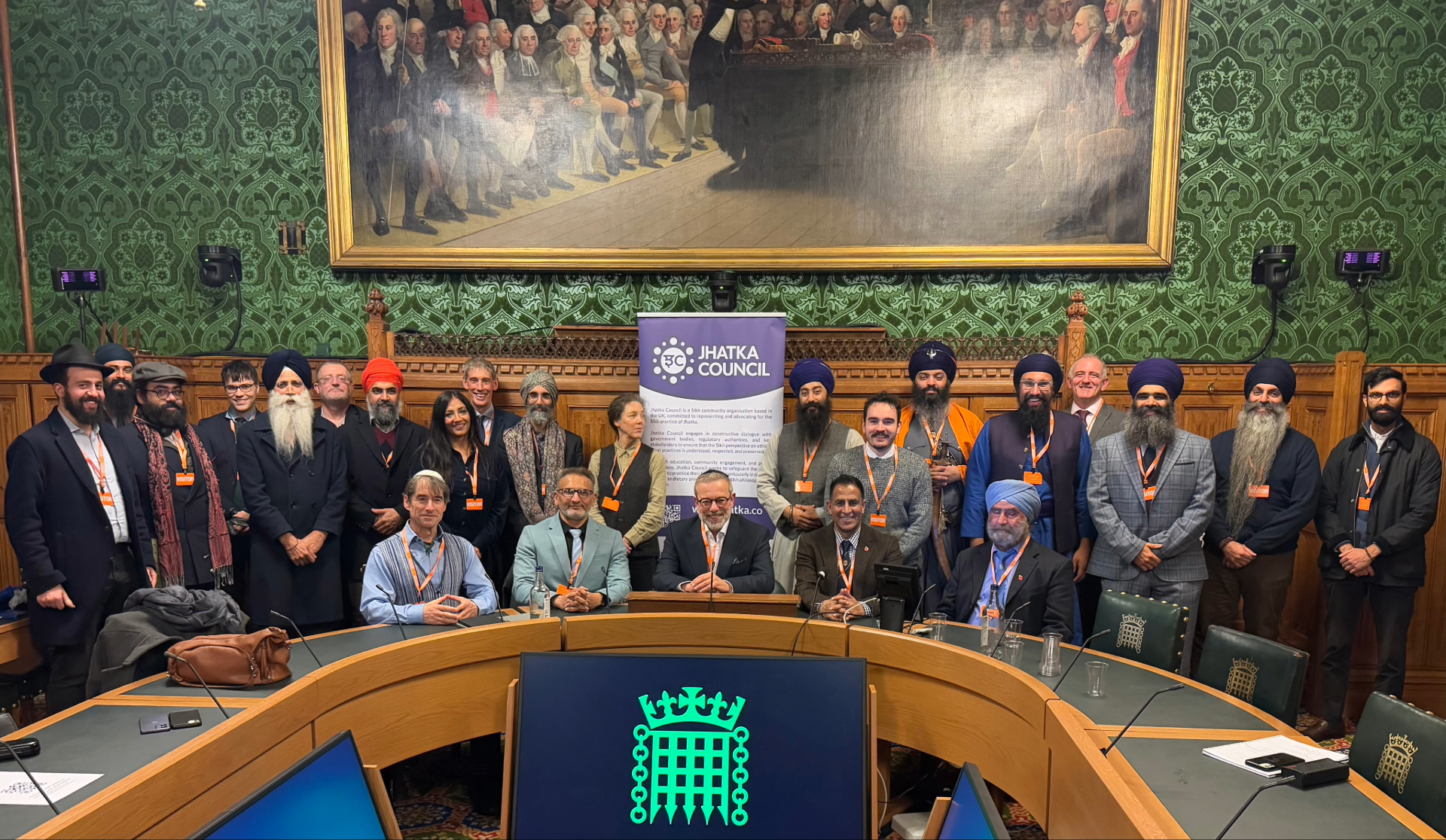
Promoting Interfaith Understanding: Parliamentary Discussion on Religious Slaughter
On Monday 15 December, an interfaith dialogue was held in Parliament examining religious approaches to animal slaughter, including the Sikh practice of Jhatka. The meeting was hosted by Gurinder Singh Josan MP for Smethwick on behalf of Jhatka Council.
Jhatka Council is a UK-based Sikh community organisation that represents and advocates for the Sikh practice of Jhatka, and remains committed to promoting understanding, respect, and constructive dialogue between faith communities.
Jhatka is the method of animal slaughter involving instantaneous decapitation. Practised by adherents of the Sikh faith, it is rooted in the principle of compassion and is intended to minimise suffering through immediacy. It is important that Jhatka is understood within its proper religious and ethical context, particularly when discussed alongside other faith-based practices.
The meeting brought together a wide range of faith leaders, policymakers, academics, veterinary professionals, and community representatives. Officials from DEFRA, AJ Gilbert and Richard Aram, attended to observe and contribute to discussions surrounding regulatory frameworks, animal welfare standards, and the interaction between religious practice and public policy.
Jewish and Islamic perspectives were presented by leading experts in their respective traditions. Shimon Cohen representing Shechita UK, and Leon Pein of Biblical Foods provided detailed explanations of kosher slaughter and its religious safeguards. Islamic perspectives on halal practice were shared by Dr Gama Khan of the British Halal Charter (Shazans) and Saqib Mohammed of the Halal Food Information Centre, who outlined both theological principles and modern certification processes.
Christian perspectives were represented by Canon Dr Andrew Smith and Siriol Davies of the Church of England, who contributed to the wider ethical discussion on compassion, stewardship, and moral responsibility in relation to animal welfare and religious freedom.
The veterinary profession was represented by James Russell and Ben O’Halloran of the British Veterinary Association, who engaged constructively in discussions on animal welfare science, industry practice, and the interface between professional standards and religious exemptions.
Academic insight was provided by Opinderjit Takhar, Associate Dean Research and Knowledge Exchange at the University of Wolverhampton, who reflected on the sociological and ethical dimensions of faith-based slaughter practices within a pluralistic society.
Representation from the Sikh community included Balbindar Singh Chaheru, Harpreet Singh, Jasmeet Singh, Sukhwinder Singh, Satpal Singh of Nanak Naam, Jasvir Singh of City Sikhs, and Jaspal Singh Swali, Deputy Lieutenant of Cambridgeshire. Their contributions provided theological, cultural, and practical insight into the historical foundations and contemporary observance of Jhatka, as well as its significance within Sikh ethics.
Together, participants explored the theological foundations and moral values underpinning each tradition’s approach to slaughter. Relevant regulations were discussed, alongside the mechanisms used by faith communities to uphold compliance and integrity. Industry perspectives also addressed how stakeholders can work collaboratively to ensure compatibility between religious observance, animal welfare, and the intent of existing legislation.
There was clear support expressed for the Sikh Jhatka method of slaughter, alongside a shared recognition of the deeply held beliefs guiding Jewish kosher and Islamic halal practices. The discussion highlighted common values across faiths, including respect for life, responsibility, and compassion, while acknowledging important differences in religious observance.
Following the meeting, Jhatka Council issued the following statement:
“It was an absolute pleasure to learn more about the Jewish and Islamic methods of slaughter and to gain a deeper understanding of the values surrounding kosher and halal practices. We would like to express our sincere thanks to Shimon Cohen, Leon Pein, Dr Gama Khan, and Saqib Mohammed for providing such a thorough and insightful exploration of this important aspect of the Jewish and Islamic faiths.
We wholly respect the right of all faiths to practise their beliefs, including our Jewish and Muslim friends, and we are committed to fostering greater empathy and understanding between Sikh, Jewish, Muslim, Christian, and secular communities.
We believe the meeting demonstrated the importance of Parliament as a space where faith communities can come together, in a spirit of mutual respect, to discuss sensitive and often misunderstood issues. We remain committed to continued interfaith engagement, grounded in dialogue, learning, and shared values.”